Failure Predictions & Prognostics for Mission-Critical Machines.
Deploying Predictive IQ and Prognostics IQ deep learning software for mission-critical machines across space, aeronautics, and defence. We train unsupervised models on healthy machine baselines first — establishing a high-dimensional health envelope to identify early degradation precursors and compute Remaining Useful Life (RUL).
Learn the Healthy Envelope
Train unsupervised deep learning neural architectures on multi-sensor machine telemetry across diverse operating envelopes, loads, RPM, and thermal regimes.
Construct Sensor Relationships
The network learns high-dimensional cross-sensor correlations and normal variance rather than relying on static single-variable threshold alarms.
Isolate Degradation Precursors
Continuously compare machine telemetry streams against learned health bounds to detect micro-deviations before conventional fault codes trigger.
Predict RUL & Action
Output actionable Health Scores (MSE reconstruction loss), Remaining Useful Life (RUL) horizons, and prioritized condition-based intervention plans.
Conventional Fault Detection vs. Deep Learning Intelligence.
Transitioning mission engineering from post-damage reactive alarms to proactive health envelope inference and remaining useful life forecasting.
Fault Signal → Reactive Response
Static limit triggers and discrete fault codes sound alarms only after physical degradation has already propagated into critical thresholds.
- Monitors isolated single-sensor parameters in silos
- Late warnings: fault flagged after damage has initiated
- High risk of unplanned downtime & mission abortion
- Zero mathematical foresight into degradation trajectory
Healthy Baseline → Deviation → Planned Action
Unsupervised deep learning masters multi-sensor interdependence, detecting anomalous signatures hundreds of flight hours prior to failure.
- Learns multi-sensor healthy operating envelope
- Ultra-early warnings: flags sub-threshold degradation
- Computes Remaining Useful Life (RUL) with confidence intervals
- Maximizes asset availability, safety, and mission readiness
How Deep Learning Predicts Failures Before Conventional Fault Signals
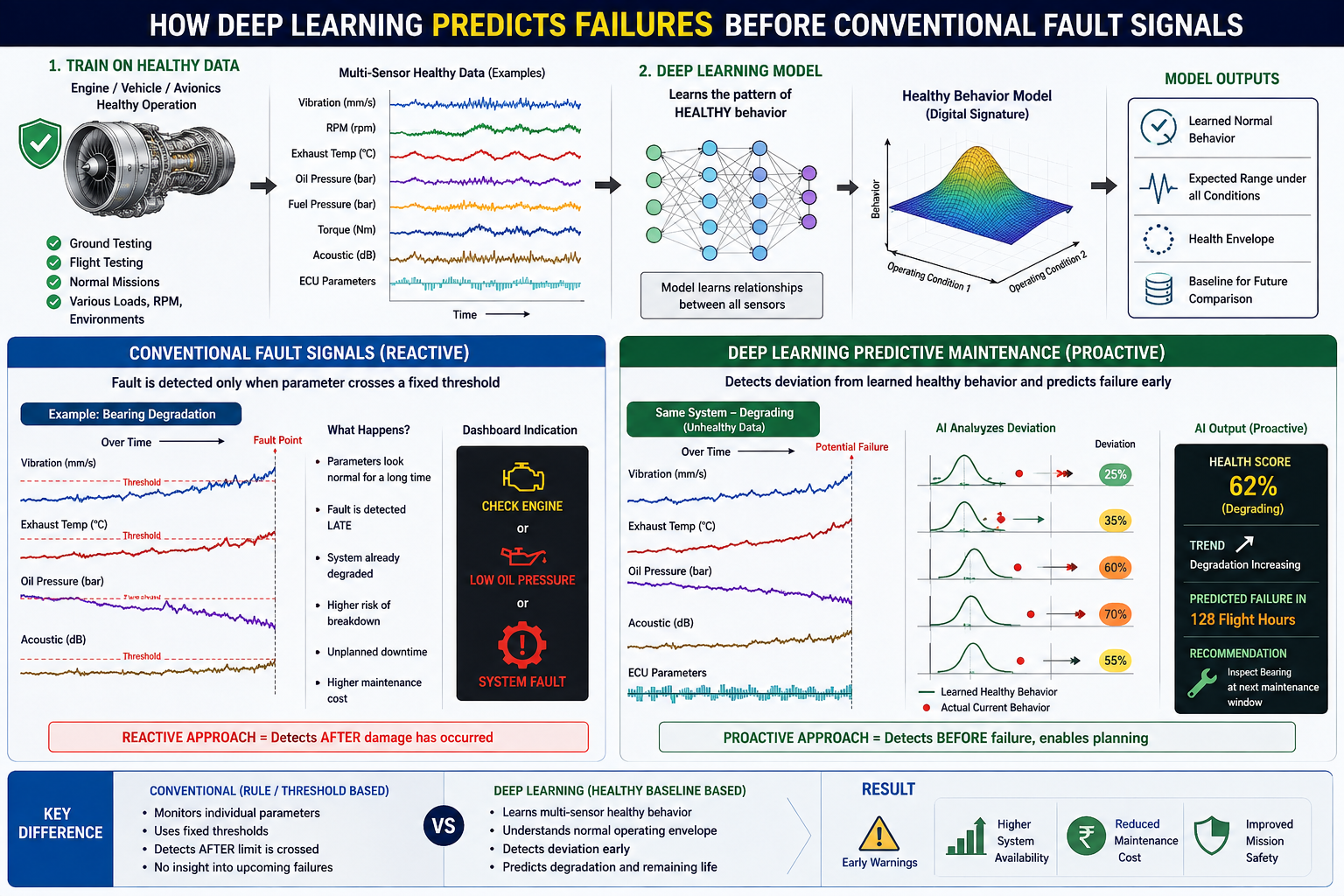
Multi-sensor healthy data: Vibration (mm/s), RPM, Exhaust Temp (°C), Oil/Fuel Pressure, Torque, ECU params.
Deep neural networks learn non-linear patterns and establish a multidimensional health manifold.
Deviation from learned manifold generates reconstruction anomaly scores.
Direct output: Health Score (e.g. 62% Degrading), 128 Flight Hours to failure, and targeted action.
Predictive IQ & Prognostics IQ.
Two CSV file-based computational deep learning software layers for transforming multi-sensor logs and telemetry files into actionable mission health foresight.
Predictive IQ
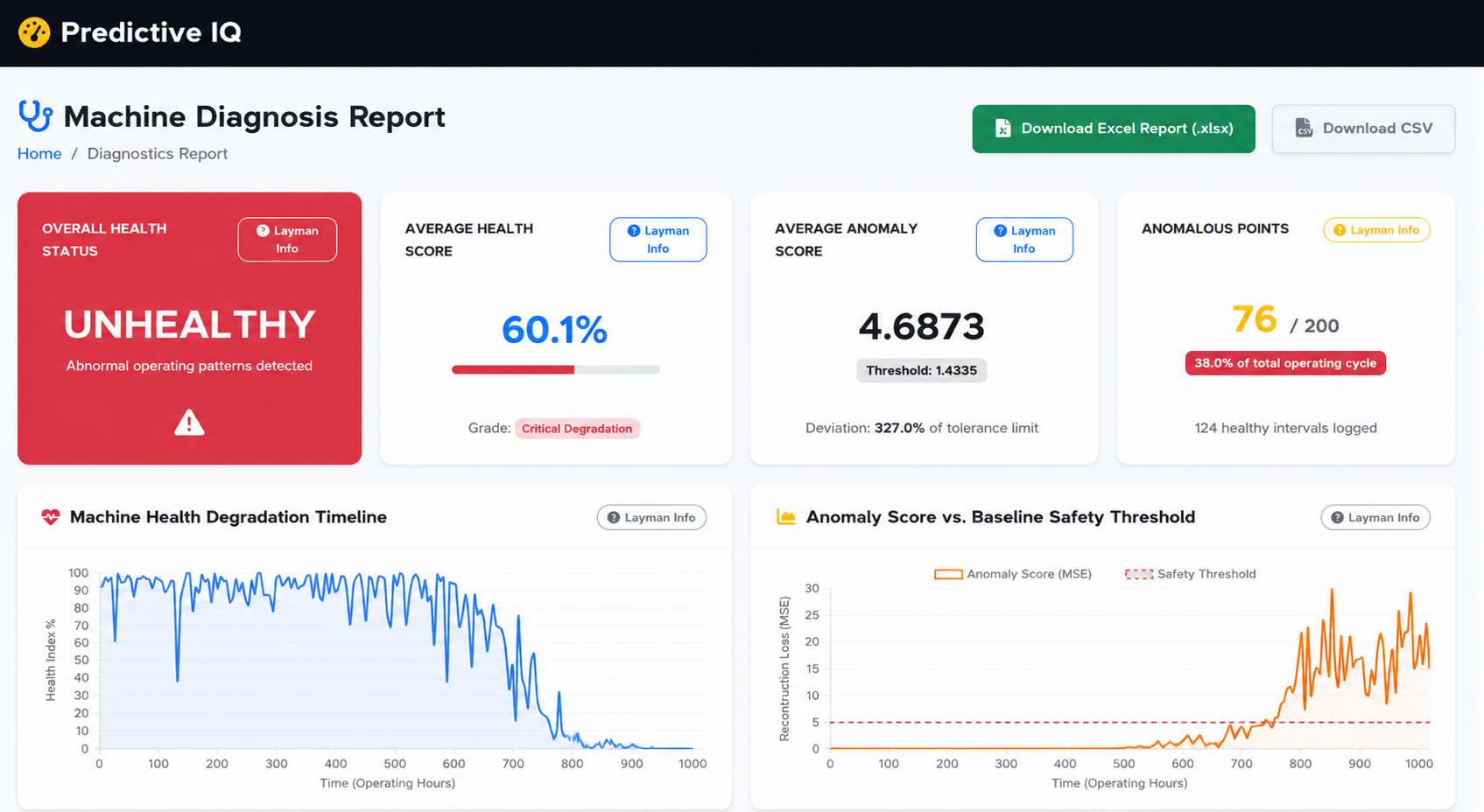
Learns baseline healthy machine operations through unsupervised deep neural networks using multi-sensor CSV datasets. Automatically evaluates CSV sensor time-series, identifies reconstruction errors (MSE), and flags early mechanical degradation before traditional fault alarms activate.
Prognostics IQ
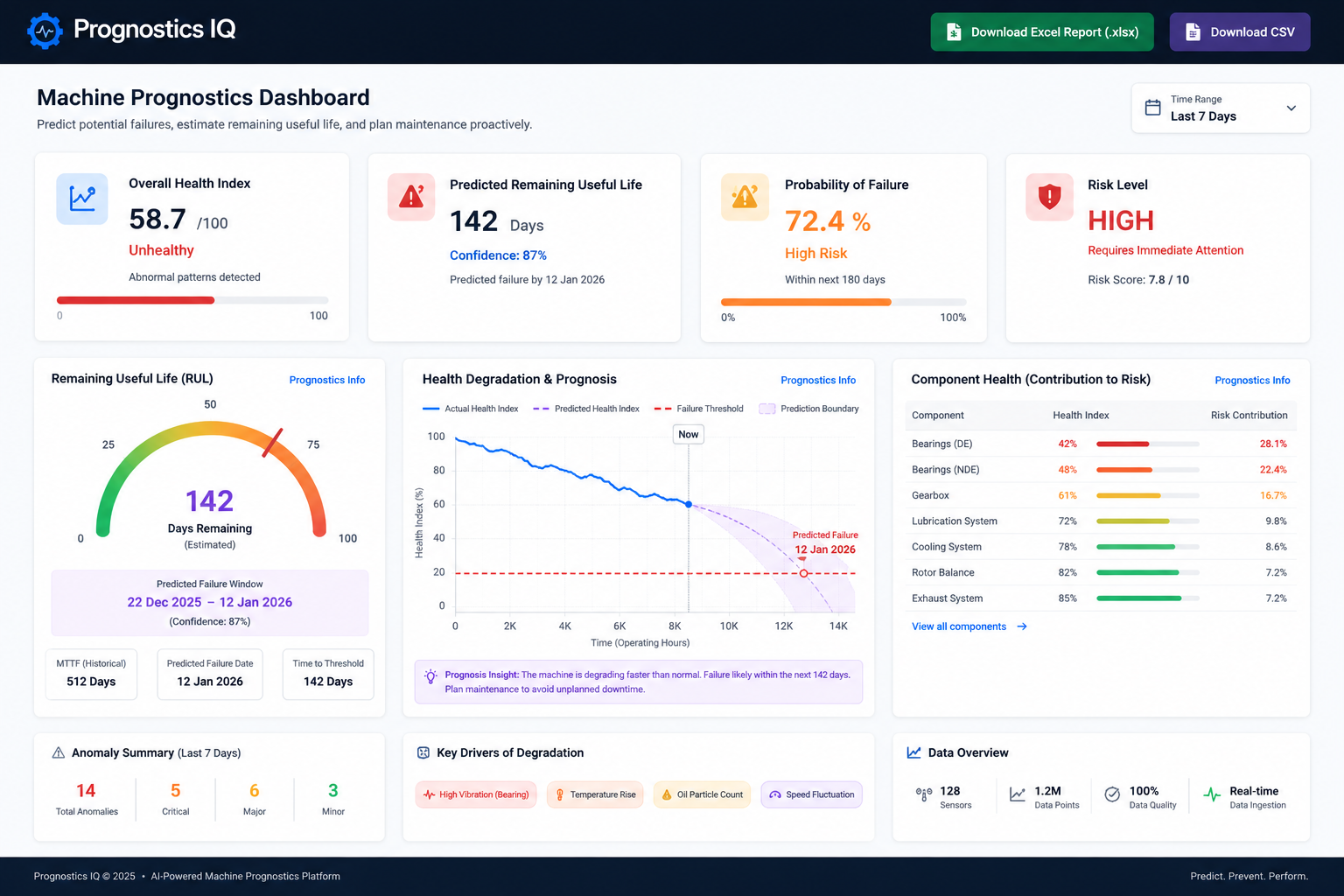
Transforms CSV machine telemetry and degradation trajectories into high-confidence machine intelligence. Computes Remaining Useful Life (RUL) estimates, component failure probabilities, and subsystem risk contribution hierarchies to schedule precision condition-based maintenance.
Critical Intelligence Across 5 Sovereign Industries.
Unsupervised deep learning health baseline modeling, precursor anomaly isolation, and Remaining Useful Life (RUL) prognostics engineered for mission-critical operations across Air, Land, Sea, Space, and Space & Defence Manufacturing.
50-Actuators & Control Systems Explorer 2,500 Actuators · 10 Telemetry Values Each
Multi-variable diagnostic & prognostic monitoring for 50 critical Flight Control (EMA/EHA), Propulsion Fuel Metering, Rotorcraft Swashplate, Thrust Vector Control (TVC), and Tactical Defence Actuation systems — mapping 50 dedicated actuators per system with 10 real-time telemetry parameters.
From Signals to Mission Decisions.
Explore our deployed application portfolio across aerospace propulsion, space launch systems, naval platforms, strategic defence, and precision manufacturing.
50-System Aerospace Explorer 2,500 Subsystems Mapped
Search and navigate across 50 critical propulsion (FADEC, EEC), rotorcraft (HUMS, Gearbox), flight control, and avionics systems — mapping 50 dedicated subsystems per main system.
Built for the Critical Scale.
Empowering space and defence enterprises to move from static machine data collection to deep learning based perception — for next-generation aerospace vehicles.
From Discrete Signals to Unified Perception
The same learning envelope extends from discrete monitoring to fusion perception, enabling deep learning models to perceive engine degradation, and complex flight anomalies with sub-millisecond precision.
DeepTech Built from First Principles.
JUDE MATHEW IRIMPEN
Jude holds a Master of Science (M.Sc.) in Renewable Electricity Production from Uppsala University, Sweden — a rigorous 120-credit, two-year research programme. He defended his Master's thesis on Deep learning using Federated Learning for Edge Computing of AI Models, and holds a B.Tech in Electrical and Electronics Engineering from Cochin University of Science and Technology.
Automatic Workflows unites senior engineers and executives with over 200+ man-years of combined expertise across the Indian Space Research Organisation (ISRO), Hindustan Aeronautics Limited (HAL), Wipro, and PhD holders from Sweden and Indian Institutes of Technology (IITs).
Build the Deep Learning Corridor With Us
Automatic Workflows is building an advanced DeepTech AI Capability Centre in Cochin, Kerala, India for specialized aerospace deep learning, and sovereign machine intelligence.
"True technological sovereignty is not a slogan. It is the sovereign capability to predict, decide, and mitigate on your own mathematical terms."